Friday, June 2, 2017

Letter to a Biology Student

Dear Biology Student,
My name is Sydney Murakami. I was in ninth grade, and I was 14 at the beginning of the school year.  I went to Redwood Middle School, and I wasn't that interested in any subjects in the beginning of the school year. The classes that I took in this year were Physical Education, Art, Spanish, English 9, Biology, Geometry, and Health in the fall and World Geography in the spring. I wasn't that excited to go to high school in the beginning of the school year because of the bell schedule and it was very different compared to middle school. But as the school year went on, I started to enjoy high school because you have more freedom than middle school such as being able to use your phones during tutorial and lunch and I find that it is less chaotic than middle school where people are running around, or interrupting during class. The only interest I have outside of school is golf, which I practice for three days during the week. Some things that I expected from the class on the first day was that I would have more homework, and that I would have to study more for tests since it makes a bigger impact on your grade than in middle school where if you do your homework your grade would be fine even though you did bad on your test.
Some of Mr. Orre's expectations are that you shouldn't interrupt him while he is talking and that you shouldn't fool around when you are doing labs in this class. The first thing I do when I come to class is get my notebook and a writing utensil for our Do Now, which is usually a question that we answer in our notebook about what we learned in our homework. A typical class day would be reviewing the homework, going over the schedule for the day, and other activities later such as labs, videos, classwork, or projects. When we do a lab, Mr. Orre gives us a handout about what the lab is about, what we are supposed to do, and the main question that we have to answer. After that, he reviews the lab, and then leaves us on our own with our group mates. Our homework is usually vodcasts, which are videos about a subject that we take notes on, and while we are doing a unit we are assigned textbook notes, where we write and answer about five questions, write vocabulary, and a relate and review about what we have learned. We have homework about everyday, but it depends on if you tend to procrastinate because sometimes we can go ahead and do later vodcasts which I suggest that you do because it helps later on when you have a lot of homework and you don't have time to do it. It usually takes me around 20 minutes or less to finish my homework and sometimes it could take 30 minutes, but it depends on what was assigned and how long the vodcasts are. It is optional to do the vodcasts until we do the notebook check during class which occurs at the end of each unit. I suggest that you should do the vodcasts and turn them in on time because if you aren't a good test taker it could help your grade a little. In this class we only do tests which we do at the end of each unit, which are usually around 50 questions. The questions on the test are from the vodcasts of the unit and what was reviewed in class, and we are allowed to write information on the test sheet once we get it so that if you think that you will forget something you can write it down. The blog that we created for this class is used to show others your work that you did in class and do something besides writing it down on paper and turning it in. My favorite blog post was the pig dissection reflection, because it is the most interesting due to the video of the pig that my group dissected and it was an activity that I enjoyed in this lab, even though at first I thought that it was gross and that it was going to smell bad. Click here to see my blog post.
Some things that Mr. Orre doesn't like is when we don't clean up lab materials properly, interrupting others when they are talking, or just fool around during class. Homework is important in receiving a good grade in class, because if you don't do your homework and don't do well on tests, then your grade wouldn't be good. Also we have more homework than tests, which can be up to around 50 points sometimes which can be worth even more than some tests, so I highly advise you to do your homework and turn it in on time. If your want to get a good grade on your test, you should study by having someone test you on what you've learned or use flashcards or another technique and not just look over the notes. You also shouldn't just think that you should just study the vocabulary because that won't help you that much on the tests. Some mistakes that I made was procrastinating on textbook notes in the beginning of the year and only looking over the notes for studying, which helped me become a better student later because I learned that it wasn't a good way to study and that it isn't good to procrastinate and save things for later.
I would rate this class a 8 out of 10, because of the labs that we did and I also think that what we learned this year was interesting and how we reviewed the information during class. Next year I am taking Chemistry because I decided that it would suit me more to do that class rather than Chemistry Honors. I hope that this information will help you later on in this class, and I hope you have fun in this class.

Signed
 -Sydney Murakami

Wednesday, May 31, 2017

Pig Dissection Reflection

The purpose of this lab was to study about the anatomy of a fetal pig, which also helped us learn more about human anatomy since there are similarities between the structures of pigs and humans. This dissection related to what we have learned in this unit by how we got to learn where the different systems are located in the animal and how structures function. My favorite part of the dissection was finding the structures and cutting the pig, because I never have done it before and it's something that I may not have the opportunity to do again. I think that this dissection was a valuable experience because I got to know more about the anatomy of a pig which is similar to a human's. Also being able to learn more with an actual organism is better than looking at a worksheet because you get to see and experience it in person.

Monday, May 22, 2017

20 Time Individual Reflection

I chose this challenge, because it seemed interesting when I learned about it in class, and I wanted to know more about genetically modified foods. For example, the pros and cons of genetically modified foods and how they are made. My goal was to see whether my prediction was correct about how people would prefer the genetically modified foods over the organic foods. My plan was to first research about the topics that I would need to conduct the experiment and learn more about the subject. After I finished researching I planned to start preparing for the experiment by getting the foods and then bringing it to school to have people rate the organic and genetically modified foods. Then after I finished my experiment I would analyze my results to see if my prediction was correct and then use my research to add more information about why my results ended up that way.

My partner and I were able to complete our project on time, but we had a few problems during the process. We were able to get results that showed that our prediction was correct, but we didn't have any information about why people preferred one food over another and what are the differences between genetically modified and organic foods. During this project, I learned that I should not procrastinate on things and that I should plan ahead when I want to complete things. If I had another chance to do this project I would spend more time on the experiment, because we were not able to have many people rate the foods and we didn't have many foods that people could try. I learned that I tend to do things later when I was supposed to do it earlier, and I tend to procrastinate because I think that I have enough time to do everything later on. 

I would not continue this challenge, because I think that I proved a point about why people prefer genetically modified foods, the advantages and disadvantages of it, and I also finished it already with m partner. If I did continue it I would add more to the experiment like using more types of food and having more people try the foods.

Wednesday, May 10, 2017

Unit 9 Reflection

This unit was on classification, which is to group organisms based on similarities, and taxonomy, the study of naming and classifying organisms. After we learned the five kingdoms, Monera, Protista, Plantae, Fungi, and Animalia, and the three domains which are Bacteria, Archaea, and Eukarya. Then we learned about viruses, which are very small infectious particles and the three most common shapes of bacteria which are spheres, rods, and spirals. Next we learned about fungi whose cell walls are made of chitin, and absorb their food through hyphae which are long strands of fungi. After we learned the major plant phyla, which are Bryophyta(Mosses), Pterophyta(Ferns), Gymnosperms(Cone bearing plants), and Angiosperms(Flowering Plants).

Towards the end we learned about the major invertebrate phyla which include Phylum Porifera which have no symmetry and are sessile, Phylum Cnidaria which have two body forms, polyps or medusas, Phylum Arthropoda which have and exoskeleton made of chitin and a jointed appendage, and others. Finally we learned about the major vertebrate phyla which include Phylum Chordata, which have an endoskeleton made of bone or cartilage, Class Agnatha which are jawless fish with two groups, hagfish and lampreys, and others. Some things that I would want to learn about is how they came up with the names for classifying organisms.

Some parts of our unit is similar to our Geologic Timeline Project, because they both included how things changed and organisms evolved over time. I think that my presentation was okay, and I could have done better in some parts during the presentation. Some things that went well was how I was able to share all my information and include information that people probably wouldn't know. What could have been better was making eye contact during some parts of the presentation, slowing down while talking, and not reading off the screen the whole time. One lesson that I will take from this experience is that I should practice more before the presentation date, and I could apply this to other presentations by using it as an example of things like what I should do later on in presentations like slowing down when speaking and trying to make eye contact.

Link to presentation-https://docs.google.com/presentation/d/1wYvefkdyrS9zcmQhfDAA0s3xdJQe2Nk4F15gUqQFpAE/edit#slide=id.p

Thursday, April 20, 2017

Geologic Timeline Reflection

One major event in Earth's history was the Cretaceous-Paleogene extinction. What made it significant was how it was the end of the dinosaurs and their was a loss of 76% of species. Another reason why it was a major event, was that because the dinosaurs became extinct it introduced other species later such as mammals, insects, and birds. Another major event was the appearance of human ancestors, which is significant because if they didn't exist we may not be here today our we could've evolved from something else. Finally, another major event was Permian-Triassic Extinction, which is significant because 96% of species became extinct and during that time there was a lack of oxygen in the ocean. 1280px-Postosuchus.jpg (1280×857)

The scale of the Earth is separated into different periods which all add to around 4.6 billion years and humans have only showed up 5.3 million years ago which is a huge difference compared to the origin of the Earth. What surprised me was that in the video we watched we are only a second out of 12 months. 

We have made a huge impact on our planet in a short time. For example we now are creating building and other things that have now replaced environments that have been there for a long time. Also we have invented many things in a short amount of time compared to the time before humans existed. 

Sunday, April 9, 2017

Unit 8 Reflection


Big_and_little_dog_1.jpg (600×504)
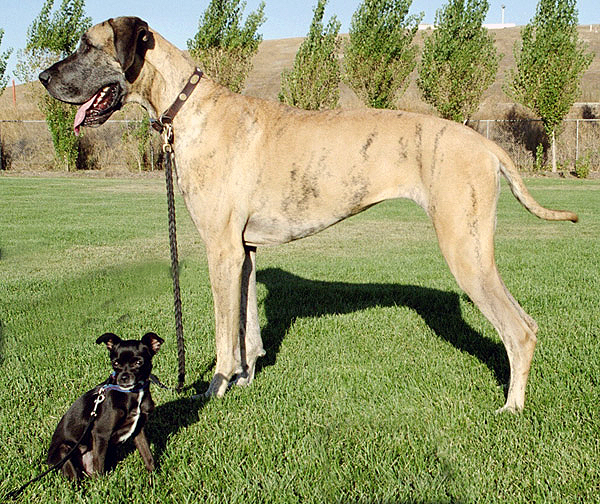
838px-Portrait_of_Charles_Darwin._Wellcome_M0010103.jpg (838×1024)In the beginning of this unit we learned about artificial selection, which is when humans select traits from a population's variation and they only mate individuals who have that trait. The result is that the species changes over time and a new breed is created. Some examples of artificial selection are dogs like collies which are used for sheep herding, and cattle which contains a lot of meat or milk. After we learned about Charles Darwin, who discovered that natural selection causes evolution, and that natural selection is a process that weeds out traits that don't help an individual survive. In the Hunger Games Lab, we conducted an experiment to see how natural selection causes a population to evolve, which relates to what we learned in this unit.

Next we learned about the gene pool which is the total of all alleles in a population, and allele frequency which is how common an allele is in a population. Then we learned about speciation, the rise of two or more species from one existing species and the causes which are behavioral isolation, geographic isolation, and temporal isolation. Later we learned about genetic drift which is when a random event drastically changes a population and gene flow which is when alleles move from one population to another. Finally we learned about the four Eras which include the Precambrian, Paleozoic, Mesozoic, and Cenozoic Era.

One thing that I would want to learn more about would be how far can humans go to change species that they want using artificial selection. One thing that I was wondering about was how did humans change species for their own purposes and how long did it take to achieve what they wanted. What I have done to be more assertive is trying to make eye contact when saying something to someone in class, and the things that I could work on is my posture because when I talk to someone my posture becomes different because for me it is uncomfortable to look in the eyes of someone else and talk about something.

Thursday, March 30, 2017

Hunger Games Lab

1. In this lab we experimented on how natural selection causes species to change and evolve over time. In this lab we stimulated a population of organisms trying to survive, which included Stumpys who could only pick up food with their wrists, Knucklers who could pick up food with their index and middle fingers, and Pinchers who picked up their food using their thumb and index finger. Using those three phenotypes for the organisms, we tried to figure out how natural selection works and if the population would evolve during our trials.

2. The phenotype that was the best at picking up food was Knucklers because you could easily pick up multiple food quickly.

3. In our population it did evolve, because in our data the population gradually became Knucklers and Stumpys decreased and at the end there was only one Stumpy in the population when there was originally ten. As shown in our graph there was an increase in the "A" allele frequency and a slight increase in the "a" allele frequency.

4. Most of the events in the lab were not-random like how where the food was placed and who each person wanted to mate with. The effects of the events caused the population to evolve because organisms like Stumpys would be able to get more food when there would be a pile of food in one area, compared to when food was equally distributed.

5. The results would have been different if the food size became smaller or larger because if the foods were bigger the Stumpys would've had an easier time to pick up food, and if the food was smaller the Pinchers and Knucklers would have an easier time. Some things that may occur in nature in how food may be too small for bigger animals to access and eat compared to smaller animals being more adapted to eating food that are smaller.

6. The results would have been different if there was incomplete dominance because then when two organisms with different phenotypes mate it would be a combination of both of the parents, compared to the lab where the offspring is either one of the parents or inherits a different phenotype that is a different combination than their parents.

7. The relationship between natural selection and evolution is that natural selection causes evolution when a species weeds out traits that wouldn't help them survive in their environment or when a species adapts to a different environment which would change how they would eat and others.

8. The strategies that individuals used and adopted in order to increase their chances of survival and reproduction were going to places with food where not a lot of people were and being more aggressive and faster when grabbing food. This would have affected the allele frequency in the population because if one species ended up surviving and reproducing more than the other species than the allele frequency for that species would raise and the others would decrease. In nature since there are limits to most things, individuals would have to compete to be able to mate with another individual and produce offspring and they would have to be able to easily access other resources in order to survive.

9. In evolution the thing that evolves are the species who are changing due to increase there chances to survive and produce offspring. I think that natural selection acts on both genotype and phenotype. For example if a bird with a big beak left one area and went to another where the food there was smaller and the bird couldn't easily pick up food, the bird would gradually have a smaller beak in order to survive better in it's environment. That would change both the bird's phenotype and genotype because the beak size changed and if the bird were to mate with another bird it would pass the big beak genotype to its offspring and not the smaller beak.

10. I don't have any questions about this subject.